
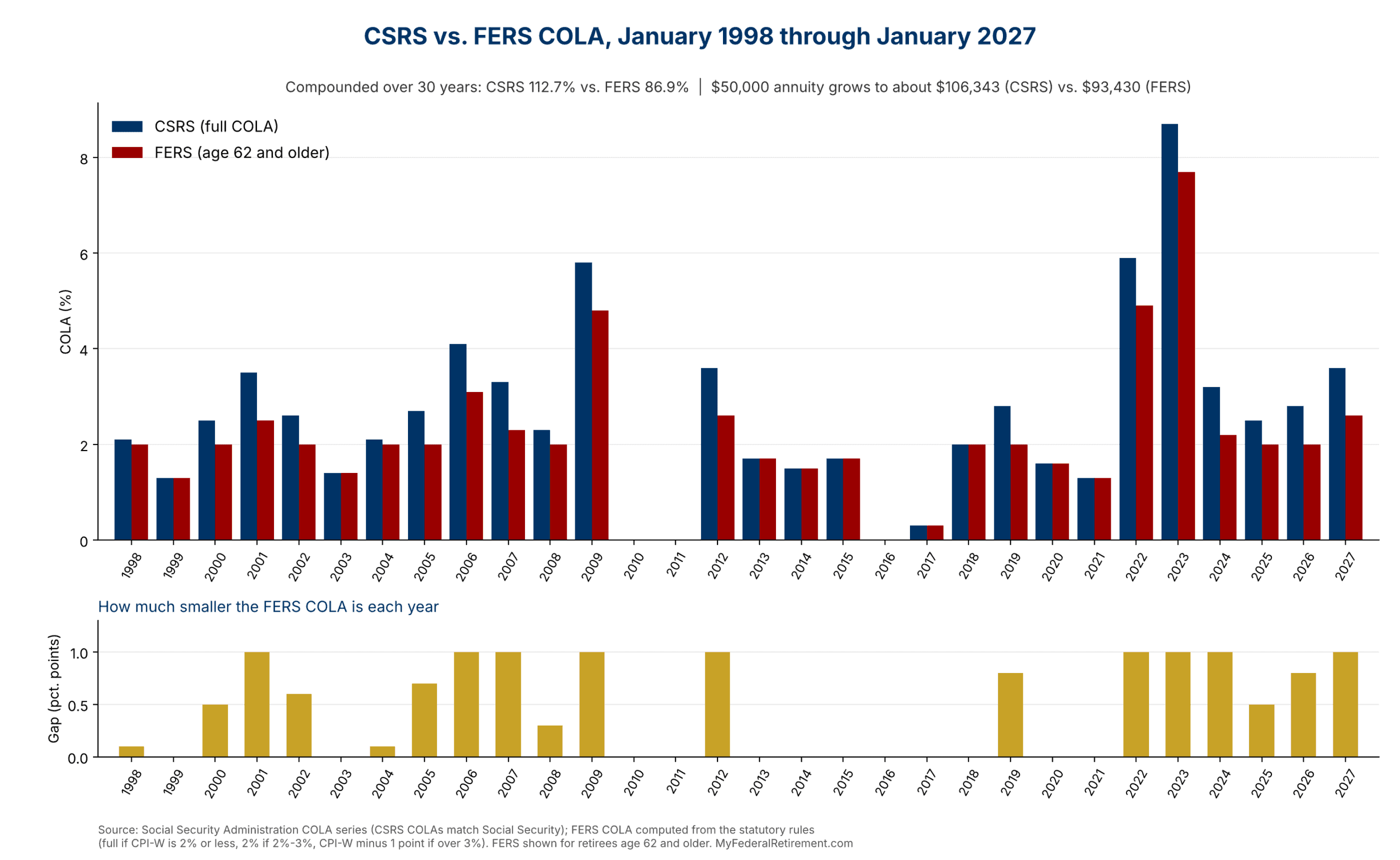
The Social Security Administration (SSA) announced on October 14, 2026, that the 2027 cost-of-living adjustment (COLA) will be 3.6 percent. Retirees under the Civil Service Retirement System (CSRS) receive the full 3.6 percent in their January 2027 payments. Most retirees under the Federal Employees Retirement System (FERS) will receive 2.6 percent, because the FERS COLA is reduced when inflation tops 3 percent. FERS retirees under age 62 generally receive no COLA at all.
That one-point difference is why many FERS retirees call it a “diet COLA,” and why bills to end it keep returning to Congress. This article covers how the gap works, what it costs in dollars, and where the Equal COLA Act stands today. The COLA Watch page tracks the full 2027 COLA trend, and the 2027 COLA Calculator shows the effect on a specific annuity.
How the 3.6 percent was calculated
Social Security and CSRS COLAs come from the same measure, the Consumer Price Index for Urban Wage Earners and Clerical Workers (CPI-W). The calculation compares the average CPI-W for July, August and September with the average for the same quarter of the base year, which is 2025. According to the National Active and Retired Federal Employees Association (NARFE), the third-quarter 2026 average was 328.746, which is 3.6 percent above the 2025 third-quarter average of 317.265. The Bureau of Labor Statistics (BLS) released the September CPI-W, 330.654, the morning of the announcement, showing a 12-month increase of 3.9 percent. BLS tied much of the increase in the broader all-items index to energy, with gasoline up 34.2 percent over the year.
For a full explanation of the method, see the guide to federal retiree COLAs.
The FERS diet COLA rules
FERS retirees receive the full inflation adjustment only when inflation is low. Above 2 percent, a cap or a reduction applies.
Ad
Retire before 62, and there’s a benefit most feds forget to plan around
The FERS Special Retirement Supplement can bridge the gap until Social Security kicks in — if you know the eligibility rules and how it’s taxed. This workshop covers it, plus everything else on your path to retirement. Get the details at a free FedImpact Workshop near you.
| CPI-W increase | CSRS and Social Security COLA | FERS COLA (age 62 and older) |
|---|---|---|
| 2.0% or less | Full increase | Same as the CPI-W increase |
| 2.0% to 3.0% | Full increase | 2.0% |
| Over 3.0% | Full increase | CPI-W increase minus 1 point |
| 2027 example | 3.6% | 2.6% |
There is also an age rule. According to the Congressional Research Service (CRS), nondisabled FERS retirees under age 62 do not receive COLAs, unless they are covered by the special provisions for law enforcement officers and related personnel with mandatory retirement ages. Survivors and disabled retirees receive FERS COLAs regardless of age. CSRS COLAs have no age requirement.
What the gap means in dollars
On a single year’s COLA, the gap looks modest. Here is the first-year difference on three sample annuities:
| Annual annuity | CSRS increase (3.6%) | FERS increase (2.6%) | Difference |
|---|---|---|---|
| $30,000 | $1,080 | $780 | $300 |
| $50,000 | $1,800 | $1,300 | $500 |
| $70,000 | $2,520 | $1,820 | $700 |
The cost grows because each year’s smaller raise becomes the base for the next one. Over the six COLAs from 2022 through 2027, the CSRS rate was higher than the FERS rate in every year:
| COLA year (paid in January) | CSRS | FERS | Gap |
|---|---|---|---|
| 2022 | 5.9% | 4.9% | 1.0 |
| 2023 | 8.7% | 7.7% | 1.0 |
| 2024 | 3.2% | 2.2% | 1.0 |
| 2025 | 2.5% | 2.0% | 0.5 |
| 2026 | 2.8% | 2.0% | 0.8 |
| 2027 | 3.6% | 2.6% | 1.0 |
| Compounded total | 29.7% | 23.3% | 6.4 |
Applied to a $50,000 annuity, six years of CSRS COLAs would bring it to about $64,800 a year, while six years of FERS COLAs would bring it to about $61,600. That is a difference of roughly $3,200 a year. The comparison is hypothetical and assumes a FERS retiree who was 62 or older for all six adjustments. Rates for 2022 through 2026 come from CRS, and the full year-by-year record is on the CSRS and FERS COLA history page.
Why FERS retirees receive a smaller COLA
Congress created FERS in the Federal Employees’ Retirement System Act of 1986 (Public Law 99-335). According to CRS, the capped COLA and the age 62 requirement were viewed by some as a compromise aimed at cost concerns, and the smaller COLA was considered part of a larger package that included Social Security and the Thrift Savings Plan (TSP).
During the House debate, Representative Michael Barnes of Maryland acknowledged that the agreement “provides only COLA minus 1 for retirees after age 62.” He argued that an indexed Social Security benefit and tax-sheltered savings could keep pace with rising costs, while noting that the burden of building those savings falls on the employee.
The Equal COLA Act: where it stands
The Equal COLA Act would remove the cap and make the FERS COLA the same as the COLA for Social Security and CSRS. It would apply to COLAs made after enactment for all FERS retirees, and it would not change the age 62 rule. If it were law today, the 2027 FERS COLA for eligible retirees would be 3.6 percent instead of 2.6 percent.
In the 119th Congress, the bill is H.R. 491 in the House and S. 624 in the Senate. Rep. Gerry Connolly introduced H.R. 491 on January 16, 2025, and Rep. James Walkinshaw later became its first sponsor. Sen. Alex Padilla introduced S. 624 on February 18, 2025.
As of October 14, 2026, Congress.gov shows 90 cosponsors on H.R. 491, made up of 87 Democrats and 3 Republicans, and 20 cosponsors on S. 624, made up of 18 Democrats and 2 independents. Neither bill has advanced beyond referral to committee, and Congress.gov lists no Congressional Budget Office (CBO) cost estimate for either one. CRS reached the same conclusion in its April 2025 analysis, which found that no version of the bill had been reported out of committee or scored by CBO.
The bill is not new. According to CRS, it has been introduced in every Congress since the 115th, as H.R. 7165, H.R. 1254, H.R. 304 and H.R. 866 in the House, with Senator Padilla’s versions as S. 4221 and S. 3194. The most recent House reintroduction drew endorsements from NARFE and the National Treasury Employees Union (NTEU). NARFE has urged passage after each COLA announcement, arguing that inflation affects FERS and CSRS retirees the same way.
Opponents focus on cost. CRS notes that the bill would raise spending from the Civil Service Retirement and Disability Fund and could raise agency contributions to FERS, and that it would apply to all FERS retirees and survivors, about 1.2 million annuitants in the Office of Personnel Management (OPM) fiscal year 2023 report. CRS does not offer a dollar estimate. It also points to the original 1986 reasoning that the capped COLA, together with Social Security and the TSP, would be enough for retirees.
Separate Social Security bills in Congress would not change how CSRS or FERS COLAs are calculated, so the Equal COLA Act remains the main proposal aimed at the diet COLA.
What to do before the January payment
- Check the January 2027 payment against the new rate: 3.6 percent for CSRS, and 2.6 percent for FERS retirees age 62 and older or otherwise eligible.
- Use the 2027 COLA Calculator to see the new monthly amount for a specific annuity.
- Review tax withholding, since a larger annuity can change the tax picture. The article on whether the 2027 COLA will increase federal income taxes explains how.
- Compare the raise with other costs that change at the start of the year, including Medicare premiums and Federal Employees Health Benefits (FEHB) premium rates.
- Follow the bills on Congress.gov using the H.R. 491 and S. 624 links above.
Sources
- Social Security Administration: Cost-of-Living Adjustment (COLA) Information for 2027
- Bureau of Labor Statistics: Consumer Price Index, September 2026
- Congressional Research Service: Cost-of-Living Adjustments for Federal Civil Service Annuities (94-834)
- Congressional Research Service: The FERS Cost-of-Living-Adjustment (COLA) and the Equal COLA Act (IF12354)
- Office of Personnel Management: Retirement Center