
What the Fed’s rate hike meant for your Thrift Savings Plan more…
Thrift Savings Plan (TSP)
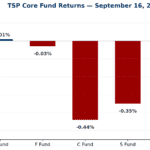
TSP Week in Review: Sept. 7 – 11, 2026

A four-day trading week brought a rough stretch for most TSP investors, as escalating tensions overseas and a hotter-than-expected inflation report weighed on stocks. Every core fund but one closed the week lower, with one fund taking a noticeably steeper hit than the rest. See which funds held up, which one struggled most, and what next week’s Federal Reserve meeting could mean for TSP balances going forward. more…
How to Maximize Your 2026 TSP Contributions and Not Lose Agency Matching Contributions

Hitting the Thrift Savings Plan contribution and catch-up contribution limits too early in the year can still cost FERS employees their agency matching contributions. Ed Zurndorfer shows you how to calculate the right per-pay-date amount, whether you’re under age 50, ages 50-59, or in the age 60-63 “super catch-up” window. more…
2026 Thrift Savings Plan Maximum Contribution Limits

The Internal Revenue Service announced the cost-of-living adjustments affecting 2026 TSP contribution limits — as well as dollar limitations for traditional and Roth IRAs and other retirement-related items… more…
Your TSP Didn’t Know You Left: What Federal Employees Need to Review After a Separation

More than 322,000 federal employees separated from service in 2025 — many well before they’d planned to — early retirements and RIFs. That kind of shift can quietly throw your TSP out of sync, because your TSP is built around one number: the year you expected to start withdrawals. It doesn’t know about your pension, your spouse’s income, or the years of runway you may actually have. Learn what “separated” really means for your TSP, why loss aversion can push people toward decisions that don’t fit their actual timeline, and the specific things worth reviewing now — your L Fund target date, your income bridge, and whether a Traditional-to-Roth conversion makes sense in a lower-income year. more…
TSP Week in Review: August 31 – Sept. 4, 2026
It was a winning week for most Thrift Savings Plan funds, with one core fund pulling well ahead of the pack while another finished in the red. Federal Reserve rate speculation and Friday’s jobs report kept investors on edge all week. See the full fund-by-fund breakdown, including every Lifecycle Fund, in this week’s TSP Week in Review. more…
Roth TSP In-Plan Conversions and the Five-Year Rule: Avoiding Tax and Penalty Surprises

After a TSP participant performs a Roth TSP in-plan conversion, two separate five-year rules apply to withdrawals from their Roth TSP balance — and they’re easy to confuse. One determines whether accrued earnings can be withdrawn tax-free; the other determines whether the converted amount is subject to a 10 percent early withdrawal penalty. Participants age 59.5 or older whose Roth TSP account is at least five years old satisfy both rules and can withdraw tax-free and penalty-free. Ed Zurndorfer explains each rule with worked examples so you know where you stand. more…
Latest TSP Fund Performance Returns — G, F, C, S, I, L Funds | August 2026

August was a clean sweep for the Thrift Savings Plan — every core fund and every Lifecycle Fund closed the month higher, a sharp turnaround from July’s mixed results. One fund led the way by a wide margin, and the year-to-date gap between the strongest and weakest core funds keeps growing. See the complete breakdown.. more…
TSP Week in Review: August 24-28, 2026
Small caps led the week’s losses as the S Fund gave back 1.32%, while the C Fund bucked the trend with a 0.50% gain. See the full fund-by-fund breakdown. more…
Roth TSP In-Plan Conversions: What They Mean for Your Taxes
Roth in-plan conversions let Thrift Saving Plan participants move money from their traditional (before-tax) balance into their Roth (after-tax) balance at any time, provided they meet eligibility requirements. But converting isn’t tax-free — the amount converted counts as taxable income in the year of conversion, and since there’s no automatic withholding, participants may need to make estimated tax payments to avoid a penalty. Ed Zurndorfer outlines who’s eligible, how much can be converted, the “leave-behind” rule, and what federal and state tax liabilities to expect. more…