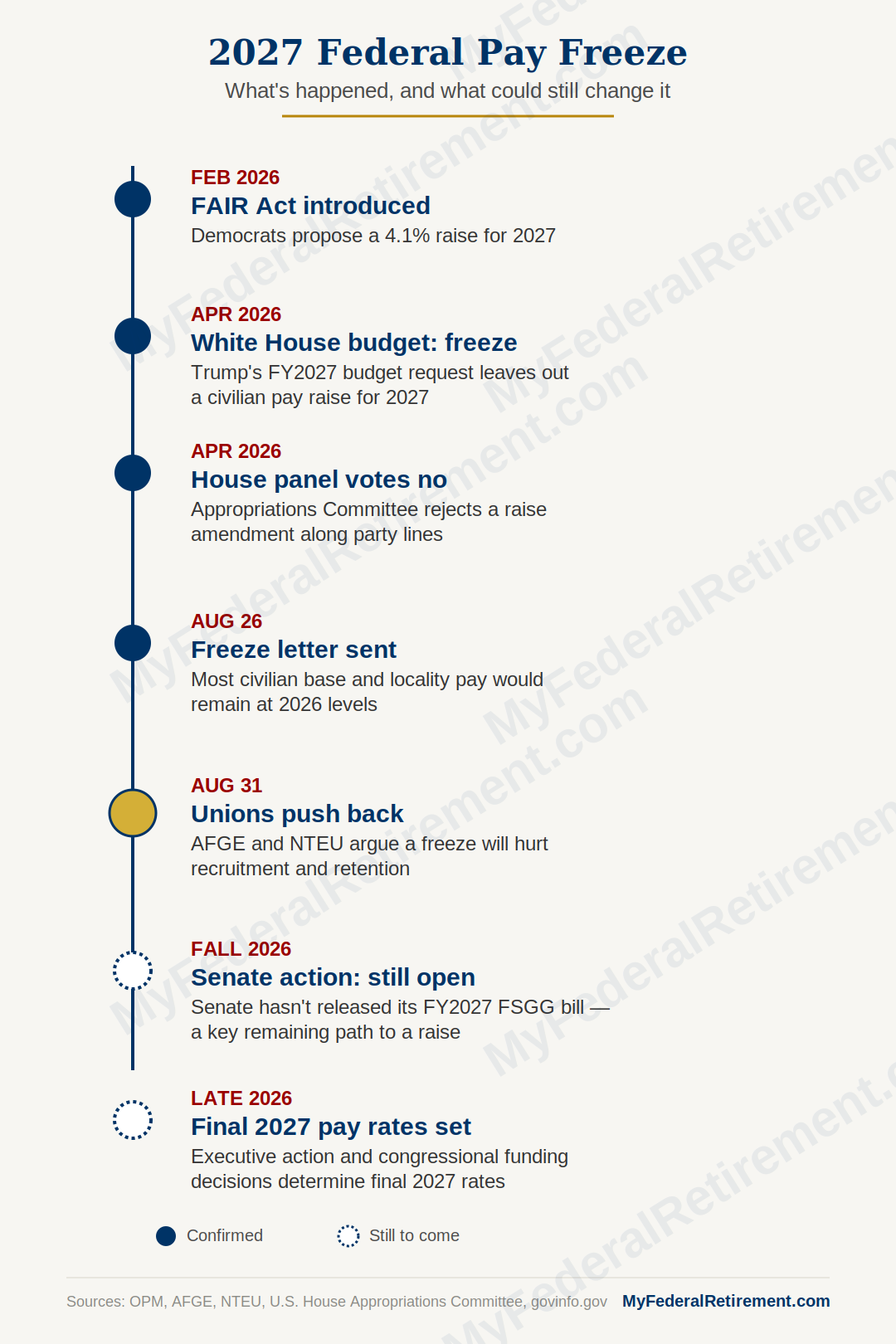
President Trump’s August 26 letter freezing most federal civilian pay for 2027 isn’t necessarily the final word — Congress can still enact a different pay adjustment. The question now is whether Congress will, and whether union pushback is likely to change the outcome.
Here’s where things actually stand, based on what Congress and the unions have put on the record.
Want to get an estimate of your pay next year? Here are the 2027 GS Pay Scale Estimated Base, Locality & LEO Pay Tables
A Pay Freeze, Right on Schedule
Under the federal pay-setting process established by the Federal Employees Pay Comparability Act of 1990(opens in new tab), statutory formulas would produce automatic base and locality pay adjustments unless the president uses his authority to set alternative adjustments. For 2027, Trump’s August 26 letter(opens in new tab), sent to House Speaker Mike Johnson, does exactly that, replacing the statutory increases with a zero adjustment to base and locality pay for most civilian employees.
Federal law enforcement personnel are the exception, with Trump directing OPM to increase their 2027 compensation by 3.8% through a separate statutory process. Active-duty military members are slated for raises between 5% and 7%, depending on rank.
The freeze and the law enforcement increase are justified with notably different recruitment-and-retention arguments. Trump wrote that freezing most civilian pay “will maintain fiscal responsibility without harming the government’s ability to recruit and retain well qualified employees.” Two paragraphs later, he described the law enforcement increase as necessary “to increase recruitment and retention” in those roles. The contrasting arguments have become a focus of union criticism.
What Would Have to Happen for This to Change
The letter establishes the administration’s position, but Congress can still enact a different pay adjustment through legislation. Historically, one place lawmakers have addressed civilian pay is the Financial Services and General Government (FSGG) appropriations process. That’s the mechanism Rep. Steny Hoyer’s office has pointed to(opens in new tab) before: during Trump’s first term, he proposed pay freezes three separate times, and Congress ultimately provided raises instead.
That history is real, but it doesn’t mean the same pattern will automatically repeat in 2027. The political and legislative circumstances are different, and Congress has already provided some clues about how difficult an override may be this time.
Where Congress Actually Stands Right Now
The House Appropriations Committee has already acted on its FY2027 FSGG bill, and the outcome runs against a raise. According to the committee’s own summary of its markup, Committee Republicans rejected a Democratic amendment(opens in new tab) that would have raised federal pay, among other Democratic amendments voted down along party lines. The House bill that emerged is silent on federal civilian pay, meaning it does not provide a legislative override of the administration’s proposed freeze.
The Senate side is the one still genuinely open. As of this writing, the Senate Appropriations Committee has not yet released its own version of the FY2027 FSGG bill, so its position isn’t locked in. Congress also has yet to complete FY2027 appropriations before the new fiscal year begins October 1, making the broader government funding negotiations another place where federal pay could potentially be addressed. Whether Congress ultimately passes full-year appropriations or relies first on temporary funding, the Senate’s FSGG bill and the eventual negotiations between the two chambers remain realistic opportunities for lawmakers seeking to replace the freeze with a raise.
Separately, the FAIR Act — the Democratic-sponsored bill proposing a 4.1% average raise for 2027 and introduced in February with bipartisan House cosponsors — has not advanced. It has not received a committee hearing or markup on its own and, at this point, functions mainly as a marker of the pay increase its sponsors and union supporters are seeking rather than as legislation currently moving toward passage.
What the Unions Are Saying
The National Treasury Employees Union addressed this broader scenario in its 2026 legislative priorities filed with Congress. NTEU argued that giving raises to the military and select worker groups while freezing the rest risks “politicizing the workforce”(opens in new tab) and could hurt recruitment and retention across the federal government.
The American Federation of Government Employees(opens in new tab) responded to the August 26 letter directly on August 31. AFGE President Everett Kelley called the proposed freeze “a slap in the face to the dedicated civil servants” who, he said, keep the nation running, and repeated the union’s figure that private-sector workers earn about 27% more on average than federal employees doing comparable work.
Kelley also pointed to the administration’s expansion of critical position pay authority(opens in new tab). President Trump has authorized OPM, in consultation with the Office of Management and Budget, to approve basic pay of up to $400,000 for as many as 400 positions supporting national-security investment programs. Kelley contrasted that authority with the proposed freeze for most federal employees and used his statement to call on Congress to pass the FAIR Act.
Is the Pushback Likely to Move the Needle?
Based on what’s on the record, the union position is clear and consistent, but the legislative path for a raise is narrower than it was during Trump’s first term. The House Appropriations Committee has already rejected an effort to add a federal pay increase to its FSGG bill, and the FAIR Act has not advanced on its own. That leaves the Senate’s still-unwritten FSGG bill and the eventual negotiations over FY2027 government funding as the most realistic remaining opportunities for Congress to change the outcome.
Public advocacy and direct lobbying of lawmakers are the primary tools available to AFGE, NTEU, and other federal employee organizations going into that window. Whether that pressure changes the outcome should become clearer once the Senate publishes its own FSGG bill and the broader FY2027 funding negotiations take shape.
This Doesn’t Touch Retiree COLAs
It’s worth separating this from a different number retirees are watching this fall. The pay freeze applies to current employees’ salaries through the federal pay-setting process described above. It has no bearing on the annual cost-of-living adjustment (COLA) that CSRS and FERS annuitants, along with Social Security beneficiaries, receive each year. That’s an entirely separate, automatic calculation tied to the Consumer Price Index for Urban Wage Earners and Clerical Workers (CPI-W), rather than the annual presidential pay-setting process.
The COLA is based on how much the average CPI-W for the third quarter — July, August, and September — rises compared with the average for the third quarter used to determine the previous COLA. Based on inflation data available so far, early estimates put the 2027 COLA around 3.5% to 3.6%, up from the 2.8% adjustment retirees received in 2026. The September inflation report is scheduled for release on October 14, providing the final CPI-W data needed to calculate the 2027 COLA. Until then, any number in circulation is an estimate, not the confirmed rate.
What This Means for You
The administration has proposed freezing most federal civilian pay in 2027, but Congress still has the ability to change that outcome. The realistic path has narrowed, however, with the House Appropriations Committee declining to include a raise and the FAIR Act showing little movement of its own. The next major question is what the Senate does.
If you’re approaching retirement, a frozen 2027 salary could have an additional effect if 2027 ultimately becomes part of your High-3 average. For everyone else, the clearest milestones to watch are the Senate’s version of the FY2027 FSGG bill and the broader government funding negotiations as Congress approaches the start of the new fiscal year.