

The retiree annuity supplement (RAS) is a monthly retirement benefit paid to those FERS employees who retire from federal service before age 62 under the FERS immediate retirement rules.
The purpose of the RAS is to provide a portion of their retirement income to FERS employees who retire before age 62. The RAS benefit is similar to what a retired FERS employee would have received in monthly Social Security retirement benefits had the employee retired at age 62 and elected to start receiving their Social Security retirement benefit.
This column presents RAS eligibility rules and calculation of the FERS Retirement Annuity Supplement.
SEE ALSO: Earnings Test of the FERS Retirement Annuity Supplement
FERS Employees Immediately Eligible for the Annuity Supplement at Retirement
A FERS employee is eligible to receive the RAS at the time of employee’s retirement from federal service if the employee meets the following requirements:
• Has at least one calendar year of FERS service.
• Retires with entitlement to an immediate FERS annuity. This means that the retiring FERS employee receives the first of lifetime FERS annuity checks one to two months after the day the employee retires:
– At or after the minimum retirement age (MRA) with at least 30 years of creditable federal service.
– At age 60 with at least 20 years of creditable federal service.
– As a Special Provision Employee (law enforcement officer, firefighter, air traffic controller, customs border or patrol officer).
– At or after MRA under a discontinued service (involuntary) retirement provision, or
– At or after the MRA under early retirement provisions – a major RIF, reorganization or transfer of function.

MRA depends on the year a FERS employee was born and is summarized in the following table:
Minimum Retirement Age According to Birth Year

FERS Employees Not Immediately Eligible for the RAS
There are some FERS employees who at the time they retire under the immediate retirement rules, are eligible for the RAS but only upon reaching their MRA rather than at the time of their retirement. These FERS employees who retire before their MRA include:
• Employees retiring before MRA under a discontinued service (involuntary) retirement.
• Employees who retire under the early retirement rules – Voluntary Early Retirement Authority (VERA) or Voluntary Separation Incentive Program (VSIP) .
• Members of Congress, or
• Senior Executive Service, Defense Intelligence Senior Executive Service, and FBI and DEA Senior Executive Service.
FERS Employees Not Eligible for the RAS
FERS employees who are not eligible for the RAS include:
• Employees who retire under a FERS Disability Retirement.
• Employees who retire under the “MRA + 10”. This includes those FERS employees who postpone the start of their FERS annuity (“postponed MRA + 10” retirement”), and
• Former employees who leave federal service (before being eligible for an immediate retirement and who are eligible for a deferred FERS annuity.
Duration of the RAS
The RAS is payable each month through the earlier of the:
(1) Last day of the month in which a FERS annuitant becomes aged 62; or
(2) Last day of the month before the first month for which the FERS annuitant would, upon proper application, be entitled to a monthly Social Security retirement benefit.
Note the following. For Social Security purposes, an individual attains or becomes age 62 on the “first moment” of the day before his or her 62nd birthday. That means if an annuitant’s 62nd birthday is October 1st, then according to the Social Security Administration he or she becomes age 62 on September 30th. An individual is also first entitled to a Social Security monthly retirement benefit (upon proper application to the Social Security Administration), beginning on the first of the month throughout which he or she is age 62 and is “fully insured” with respect to Social Security (that is, the individual has earned a minimum 40 credits of Social Security).
The following examples illustrate:
Example 1. Madeline retired from federal service under FERS on December 31, 2025. She had 25 years of service under FERS. She was aged 60 when she retired. Her date of birth is September 1, 1965. Madeline has been receiving her RAS since she retired. Madeline’s RAS will stop on August 31, 2027. This is because Madeline becomes age 62 on September 1, 2027. As a result, she will be considered age 62 on August 31,2027 and therefore her RAS will cease on that date.
Example 2. Carl retired from federal service at age 60 on December 31, 2025, with 27 years of federal service. Carl’s date of birth is September 2, 1965. Carl has been receiving his RAS since he retired and will be eligible for Social Security benefits beginning on September 1, 2027. The month of September 2027 will be Carl’s first full month as a 62nd year old. However, if Carl were not entitled to Social Security benefits (because he is not “fully insured” – has not earned during his working lifetime a minimum 40 credits of Social Security) , his RAS will continue until September 30, 2027. This is because September 30 is the last day of the month on which Carl will be aged 62.
How the FERS Retirement Annuity Supplement is Calculated
The RAS is calculated by OPM’s Retirement Office as if the retired FERS employee were age 62 and “fully insured” (has earned during the annuitant’s lifetime a minimum 40 credits) for a monthly Social Security retirement benefit at the time the RAS begins. OPM first estimates what the retired FERS employee’s full career Social Security benefit would be. Then OPM will calculate the amount of civilian service under FERS and reduce the estimated full career Social Security benefit accordingly.
To calculate the RAS, OPM determines the monthly Social Security benefit as if the retiring FERS employee started collecting his or her monthly Social Security retirement benefit at age 62. Note that the amount of this Social Security benefit at age 62 can be obtained if the employee has a Social Security online account (www.ssa.gov/myaccount). Once that amount is obtained, the RAS is determined by dividing the number of the employee’s FERS service years (rounded to the nearest full year) by 40. That figure is then multiplied by the estimated monthly Social Security benefit at age 62. The following table presents the steps in the calculation:
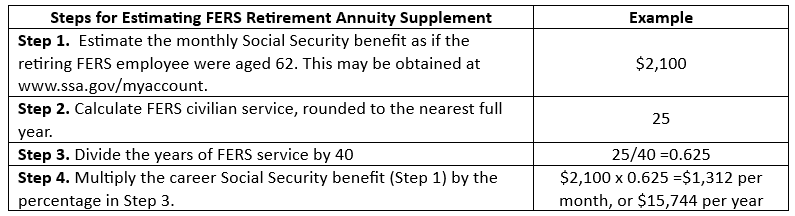
Note the following:
1. The RAS is in addition to the FERS annuity the retired FERS employee is receiving.
2. The RAS automatically stops in the month that a FERS annuitant becomes age 62 while the FERS annuity continues until the retired FERS dies.
3. The RAS receives no cost-of-living adjustment (COLA).
4. Creditable FERS service used in the calculation of the RAS (Step 2 in the table) includes full-time and part-time federal service in which FERS contributions were deducted bi-weekly from the FERS employee’s salary. Also included in the calculation of the RAS is temporary (‘non-deduction”) federal service time (occurring before January 1, 1989) for which a full deposit was made.
5. Not included in the RAS calculation are deposits for active-duty military time and unused sick leave hours. Unused sick leave hours on the day a FERS employee retires are converted to months and days and added to the employee’s existing total service time for the sole purpose of calculating the retiring employee’s FERS annuity. Unused sick leave hours when converted to months and days of service are not used for either FERS retirement eligibility or in the calculation of the RAS.
6. The RAS is not payable to FERS employees retiring under an immediate or postponed “MRA + 10” retirement.
7. The RAS is fully subject to federal income tax and, in states with a state income tax, to state income tax.
 Edward A. Zurndorfer is a CERTIFIED FINANCIAL PLANNER®, Chartered Life Underwriter, Chartered Financial Consultant, Registered Health Underwriter and Enrolled Agent in Silver Spring, MD. Tax planning, Federal employee benefits, retirement and insurance consulting services offered through EZ Accounting and Financial Services, located at 833 Bromley Street Suite A, Silver Spring, MD 20902-3019