
Over the years and especially during COVID 19 between 2020 and 2022, there have been a number of federal employees who died while in federal service. The question becomes when a federal employee dies while in federal service, what type of survivor benefits family members (a spouse and children) are eligible for survivor benefits This column discusses spousal benefits that are given to a surviving spouse upon the death of a married federal employee. Subsequent MFR columns will discuss survivor benefits given to former spouses and children of deceased employees.
Since there are relatively few CSRS and CSRS Offset employees currently working in federal service, the discussion is focused entirely on survivor benefits for spouses of deceased employees covered by the Federal Employees Retirement System (FERS).
The Basic Employee Death Benefit
The basic employee death benefit (BEDB) is a lump sum death benefit payment made to the surviving spouse of a deceased FERS-covered employee. In order for the BEDB to be payable to the surviving spouse, the deceased employee must have: (1) Completed at least 18 months of creditable civilian service under FERS; and (2) Died while subject to FERS retirement contributions (made via payroll deduction each pay period to the FERS Retirement and Disability Fund). Note that a deceased FERS-covered employee includes an employee who had applied for retirement but had not yet separated from federal service prior to his or her death.
In determining whether an employee has completed 18 months of potentially creditable civilian service, the following federal services are included in the 18 month determination: (1) Service included in a CSRS component (“Trans” FERS employee) including refunded CSRS service; (2) CSRS Offset service for which the employee received a refund before becoming covered by FERS; (3) FERS service for which FERS contributions (made via payroll deduction) remain to the employee’s credit; and (4) Nondeduction (“temporary”) service performed prior to Jan. 1, 1989, regardless of whether a deposit for such service has been made.
For purposes of the 18-month federal service requirement, creditable service does NOT include: (1) Refunded FERS service; (2) Nondeduction (temporary) service performed after December 31, 1988, and (3) Service performed after Dec. 31,1988 under another retirement system for federal employees. Such service is not creditable under FERS for any purpose. The exception is service that is creditable under the Foreign Service Pension System (FSPS) provided that the surviving spouse waives credit for the service under the FSPS and makes a deposit for the service.
Amount of the BEDB
The BEDB is equal to:
$15,000 (increased by all CSRS COLAs beginning December 1, 1987 until the year of the employee’s death), plus 50 percent of the deceased employee’s final salary (SF 50 salary), or if higher, 50 percent of the employee’s high-three average salary at the time of the employee’s death.

The following table presents how the $15,000 amount has increased through CSRS COLAs starting Dec. 1, 1987:
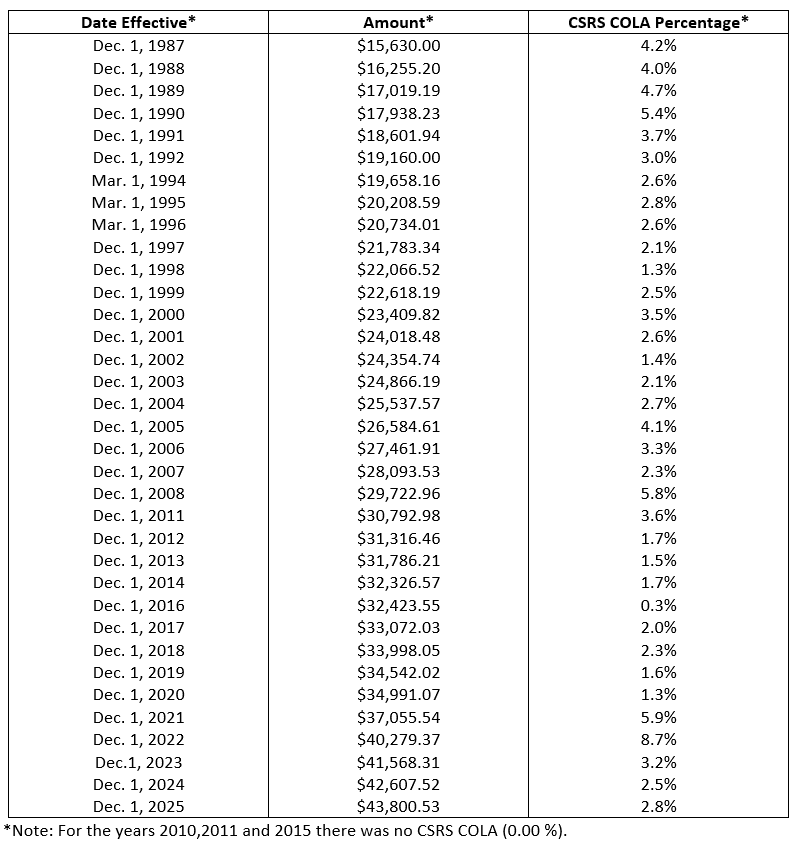
To determine a full-time employee’s salary, the employee’s basic pay (current year Form SF 50 salary) as of the date of death is used. For part-time employees, the final salary is prorated according to the tour of duty that was in effect immediately before death. The high-three average salary for the purpose of the BEDB is computed in the same way as for FERS annuity computation purposes. If the deceased employee had less than three years of service at the time of their death, the salary is averaged for the total period of service.
If the deceased employee had “non-deduction” (temporary) service prior to January 1,1989 for which no retirement contributions were made, and a deposit must be made in order to: (1) Meet the 18-month minimum service requirement for a death benefit; or (2) Achieve the 10 years of service necessary for a monthly survivor benefit, then OPM will withhold the amount of the deposit owed (including interest) from the BEDB.
Payment of the BEDB to the Surviving Spouse
The surviving spouse must elect whether to receive the BEDB in: (1) One payment (see below “taxation rollover option” information); or (2) 36 monthly payments.
The surviving spouse’s election of one payment or 36 payments is made on Form SF 3104B (https://www.opm.gov/forms/pdf_fill/sf3104b.pdf) after the employing agency inserts the amounts payable.
To determine the amount of each monthly installment, the total amount of the BEDB is multiplied by the factor appropriate for the date of death of the employee. The current (2026) factor for deaths occurring after October 1,2021 is 0.0294259. The following example illustrates:
Example 1. Rita was a married FERS employee with 15 years of FERS service when she suddenly died on March 3, 2026. At the time of her death Rita’s SF 50 salary was $122,500 and her high-three average salary was $121,800. Rita’s BEDB is therefore:
$61,250 (50% of $122,500) + $43,800.53 = $105,050.53
Rita’s husband Jerry elects to receive the $105,050.53 in 36 monthly installment payments.
$105,050.53 x 0.0294259 = $3,091.21
Jerry will receive 36 monthly payments of $3,091.21 each for a total of $111.283.43. The total amount due Jerry is larger than the BEDB amount of $105,283.53 because it includes interest of $6,232.90.
The surviving spouse may at any time elect to stop receiving the BEDB in installment payments and receive a lump-sum payment of the unexpended balance. The balance of the lump-sum payment will be less than the sum of the remaining installment payments because the interest ceases on the date of the last monthly installment payment.
If the surviving spouse chooses to receive 36 monthly installment payments but dies before the completion of these payments, any unexpended balance will be paid in a lump-sum to the survivor spouse’s next of kin. The amount of the lump-sum payment will be less than the sum of the remaining payments because the interest portion of the monthly payment ceases on the date of the last monthly payment.
Taxation of the BEDB and the Rollover Option
When received as a lump sum, the BEDB is fully taxable to the surviving spouse. If taken in installment payments, both the monthly principal payment and the interest portion of the monthly payment are fully taxable to the surviving spouse. Mandatory federal income tax withholding of 20 percent will be imposed on the lump sum payment or installment payments. The surviving spouse is responsible for paying state and local income taxes due on the BEDB lump sum payment and monthly installment payments.
The surviving spouse is given the option to rollover the BEDB to a traditional IRA. The surviving spouse should be given “IRA Rollover Option” information, including the “Death Benefit Payment Rollover Election” form. If so elected and the survivor spouse elects a direct rollover to his or her traditional IRA, the deceased employee’s payroll processing office will directly transfer the BEDB to the surviving spouse’s traditional IRA with no federal income tax withholding. The surviving spouse will be taxed on the BEDB when it is withdrawn from the traditional IRA penalty-free any time after the surviving spouse becomes age 59.5.
A surviving spouse who is a federal employee and who owns a traditional TSP account can request a direct transfer of the BEDB to his or her traditional TSP account. The surviving spouse will be taxed on the BEDB when it is withdrawn from the traditional TSP when the surviving spouse leaves or refires from federal service after age 55.
Eligibility for FERS Spousal Survivor Annuity Benefit
In addition to the BEDB, a surviving spouse is eligible to receive a surviving FERS annuity if the deceased FERS employee’s spouse met the following two conditions: (1) Completed at least 10 years of total creditable service; and (2) Died while subject to FERS deduction.
With respect to total creditable service:
1. Creditable civilian service. For purposes of the minimum 10 years of service, creditable civilian service is determined the same way as for the BEDB. See “potentially creditable civilian service” above.
2. Creditable military service. For determining whether the deceased employee completed 10 years of total service, all active-duty military service, subject to certain deposit requirements (discussed below) will be used. Also, surviving spouses of FERS employees who were Uniformed Services retirees may receive credit for creditable military service, even though at the time of death the employee had not waived his or her military retirement pay.
Amount of the FERS Spousal Survivor Annuity Benefit
A spousal FERS survivor annuity is computed as if the deceased employee had retired optionally with no age reduction on the date of his or her death. The following example illustrates:
Example 2. Jason was a married FERS employee who died at age 48 with 21 years of FERS service. At the time of his death Jason’s high-three average salary was $120,000. He also had 6 months of unused sick leave at the time of his death. Jason’s spouse Cindy is entitled to the maximum FERS spousal survivor annuity benefit of 50 percent, computed as follows:
50 percent x $120,000 x 1.0 percent x 21.5 = $12,900.
Deceased Law Enforcement Officers, Firefighters, Air Traffic Controllers (ATC) and Customs Border and Patrol Officers (Special Provision Employees (CBPO)
The FERS spousal survivor annuity is 50 percent of the FERS annuity computed under the special formula for law enforcement officers, firefighters, ATC and CBPO if, on the day of death, the employee was: (1) Age 50 or older and had at least 20 years of law enforcement and/or firefighter service, or 20 years of air traffic controller service; or (2) Was any age with at least 25 years of law enforcement and/or firefighter service, or 25 years of air traffic controller service. If at the death of the deceased employee did not meet the age and/or service requirements stated in the previous paragraph, then the spousal survivor annuity is computed under the regular formula – number of years of service including unused sick leave times 1 percent times high-three average salary.
Crediting Post-1956 Military Rules Under FERS Rules
Payment or non-payment of the military deposit may affect the amount and/or the payment of the FERS spousal survivor annuity. The following examples illustrate:
Example 3. A deceased FERS employee had 10 years of federal service under FERS and 5 years of post-1956 military service for which a deposit is owed but not paid. If the surviving spouse elects not to make the military deposit, the survivor annuity will be computed based on 10 years of service. If the surviving spouse makes the deposit, then the spousal survivor annuity will be computed based on 15 years of service.
Example 4. Assume a deceased employee had 6 years of federal service under FERS and 5 years of post-1956 military service for which a deposit is owed but not paid. If the surviving spouse elects not to make the military deposit, no survivor annuity is payable. If the surviving spouse makes the deposit, the combined civilian and military service will enable the surviving spouse to meet the 10-year service requirement for payment of a FERS spousal survivor annuity.
Crediting Pre-1989 Non-Deduction (Temporary) Service Under FERS Rules
Payment or non-payment of the deposit for nondeduction (temporary) pre-1989 civilian service of a deceased FERS employee may affect eligibility to receive eligibility for the FERS spousal survivor annuity and the amount of the FERS spousal survivor annuity. This is identical to the payment of a military deposit for a deceased FERS employee who had not made his or her military deposit.
Procedures for Applying for a FERS Spousal Survivor Annuity
The following forms must be filed by a surviving spouse of a deceased FERS employee. These forms may be downloaded from www.opm.gov/forms, and when completed are to be submitted to OPM’s Retirement Office. The address is shown on each of the forms:
1. Form SF 3104: Application for Death Benefits Federal Employees Retirement System
2. Form SF 3104B: Documentation and Elections in Support of Federal Employees Retirement System Application for Death Benefits When Deceased Was an Employee at the Time of Death
3. The survivor’s “Military Service Election” which is part of form SF 3104B
4. Form SF 3108 (Application to Make Service Credit Payment for Civilian Service) (if a deposit for non-deduction” (temporary) service prior to January 1, 1989 will be made.
 Edward A. Zurndorfer is a CERTIFIED FINANCIAL PLANNER®, Chartered Life Underwriter, Chartered Financial Consultant, Registered Health Underwriter and Enrolled Agent in Silver Spring, MD. Tax planning, Federal employee benefits, retirement and insurance consulting services offered through EZ Accounting and Financial Services, located at 833 Bromley Street Suite A, Silver Spring, MD 20902-3019