
Federal employees could get 12 weeks of paid leave to cover a serious illness, care for a sick family member, or handle military-family needs, under a bill Congress.
The Medicare IRMAA Cliff: How a TSP Withdrawal Can Bite Back Two Years Later
A TSP withdrawal or Roth conversion can look harmless today — until it shows up two years later as a $2,300 Medicare surcharge. Here’s how the IRMAA “cliff” works, and the one move that can help you avoid it.
Federal Retiree COLA History: CSRS COLA and FERS COLA

See every CSRS and FERS COLA since 1999, and how the two are calculated differently.
2026 Federal Holidays – Official OPM Schedule

2026 Federal Holidays: See the full OPM schedule, plus what’s ahead for 2027 and how holiday pay works if you’re scheduled to work.
TSP Week in Review: July 20–24, 2026
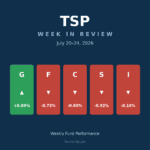
A tech-driven sell-off mid-week pulled most TSP stock funds lower, though a Friday rebound softened the losses. The S Fund led declines at -0.92%, while the G Fund was the only fund in the green, up 0.09%. See the full fund-by-fund breakdown and what drove the week.
FEHB Privacy: What OPM’s New Data Rule Means for You

OPM finalized a rule last month expanding the health claims data it collects from FEHB and PSHB insurance carriers — including more detailed prescription, provider, and billing codes. The agency states it needs to do this to catch healthcare fraud, waste, and billing abuse. While OPM states enrollees’ privacy is protected, the National Active and Retired Federal Employees Association (NARFE) has pushed back, saying the safeguard falls short of HIPAA’s standard. Here’s what’s actually collected, how it’s protected, and what critics still want changed.
Why Your Financial Planner and CPA Should Be Talking to Each Other About Your Federal Taxes Right Now

People rarely think about their finances in the summer months. Tax season is over and Open Season is months away. But for federal employees and retirees, summer sits in the middle of a tax year that still has time left to course correct. There are decisions that hurt people in April, such as underpaid estimated taxes, a TSP withdrawal that pushed them into a higher bracket, or a Roth conversion that happened at the wrong amount. These decisions were usually made months earlier, like now, without anyone connecting the dots.
Would a Flat-Dollar COLA Help or Hurt Federal Retirees?

A new proposal would replace Social Security’s traditional percentage-based cost-of-living adjustment (COLA) with a flat-dollar increase for all beneficiaries. While the idea is not legislation, it has sparked debate over how future COLAs should be calculated. Here’s what the proposal would do, who could be affected, and what federal retirees should know.
Federal Retiree COLAs Could Be Higher Under Different Inflation Index, Report Says

A new Congressional Research Service report is renewing debate over whether retirement cost-of-living adjustments (COLAs) should be based on how retirees actually spend their money instead of the inflation experienced by working households. While the report finds that a retiree-focused inflation index would have generally produced slightly higher COLAs over the past four decades, no changes to federal law are currently under consideration. Here’s what federal employees and retirees need to know about the proposal, why it matters, and whether it could affect future COLAs.
Bipartisan Senate Proposal Would End Government Shutdowns by Keeping Congress in Session

A bipartisan Senate bill would shift the consequences of missed funding deadlines from federal employees to Congress by replacing government shutdowns with automatic temporary funding while lawmakers complete appropriations. If passed, the legislation could spare federal employees from future government shutdowns by preventing furloughs, ensuring uninterrupted pay, and keeping agencies operating while Congress finishes its budget work.