
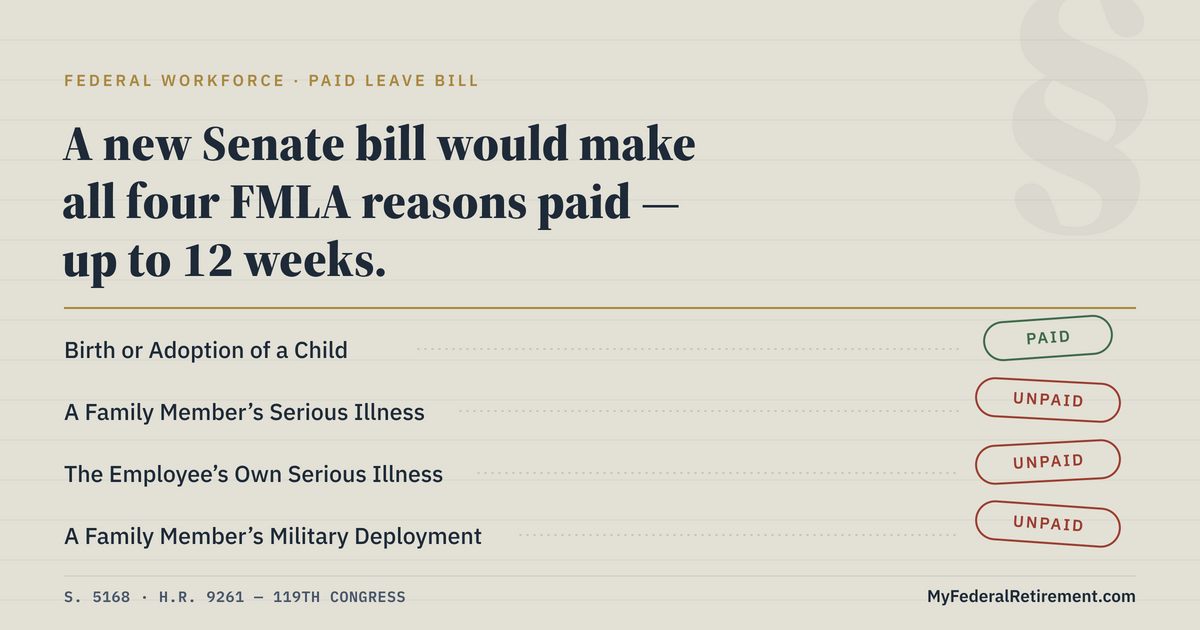
Federal employees who need extended time away from work because of their own serious illness or to care for a sick spouse, child or parent are currently entitled to job-protected FMLA leave, but the FMLA entitlement itself is generally unpaid. Employees may use accrued sick or annual leave when permitted, but once those balances are exhausted, the remaining absence may be leave without pay.
On July 29, 2026, Sen. Brian Schatz (D-HI) introduced the Comprehensive Paid Leave for Federal Employees Act(S. 5168), joined by Sen. Alex Padilla (D-CA) and six other Democratic cosponsors. A companion bill, H.R. 9261, was introduced in the House by Rep. Don Beyer (D-VA) on June 11, 2026. Together, the bills would allow eligible federal employees to receive up to 12 weeks of paid leave for additional reasons currently covered—but generally not paid—under the Family and Medical Leave Act.
What the Bill Would Change
Under current law, most federal employees are entitled to up to 12 unpaid workweeks of FMLA leave under 5 U.S.C. §§6381–6387 for several categories of need: the birth or adoption of a child, caring for a family member with a serious health condition, the employee’s own serious health condition, or certain military-family exigencies. Federal law also provides a separate, potentially longer FMLA entitlement to care for certain covered servicemembers, which is not the primary subject of this proposal.
Only one of those categories is currently paid. The Federal Employees Paid Leave Act of 2019 (Public Law 116-92) allows employees to substitute up to 12 weeks of paid parental leave for unpaid FMLA leave connected to the birth, adoption, or foster placement of a child, effective for qualifying events on or after October 1, 2020, according to the Office of Personnel Management’s implementing regulations. The federal FMLA entitlement for an employee’s own serious illness, family caregiving or a qualifying military-family exigency remains unpaid, although employees may substitute eligible accrued leave under existing rules.
S. 5168 and H.R. 9261 would amend chapter 63 of title 5 of the U.S. Code to extend paid status to those remaining categories: caring for a spouse, child, or parent with a serious health condition; an employee’s own serious health condition; and qualifying exigencies arising from a family member’s active-duty military service. Employees would need at least 12 months of qualifying federal service to be eligible, mirroring the existing FMLA service requirement.
How We Got Here: A Recurring Push Since 2019
This is not a new idea. The House originally passed a comparable paid-leave expansion as an amendment to the fiscal year 2020 National Defense Authorization Act, but during conference negotiations with the Senate the provision was narrowed to cover parental leave only — the version that became law as FEPLA in December 2019.

Advocates have reintroduced the broader version in every Congress since:
- 2019, original push: Rep. Maloney and Sen. Schatz first introduced the broader Federal Employee Paid Leave Act, before it was narrowed to parental leave only in the NDAA conference.
- 117th Congress (2021-2022): H.R. 564, introduced by then-House Oversight and Reform Chairwoman Carolyn Maloney (D-NY) in January 2021, and S. 1158, introduced by Sen. Schatz that May.
- 118th Congress (2023-2024): H.R. 856 and S. 274, reintroduced by Rep. Beyer and Sen. Schatz.
- 119th Congress (2025-2026): H.R. 9261 and S. 5168, the current versions.
None of the standalone reintroductions has passed either chamber. The bill’s history illustrates a familiar pattern in federal-workforce legislation: broad union and advocacy-group support, routine reintroduction each Congress, and no floor action to date.
Bicameral, but Not Uniformly Bipartisan
The Senate bill’s cosponsor list is entirely Democratic: Padilla, Bernie Sanders (I-VT), Tammy Duckworth (D-IL), Kirsten Gillibrand (D-NY), Chris Van Hollen (D-MD), Elizabeth Warren (D-MA), and Martin Heinrich (D-NM). It has been referred to the Senate Committee on Homeland Security and Governmental Affairs, with no hearing scheduled as of this writing.
The House version has drawn at least one Republican cosponsor, Rep. Brian Fitzpatrick (R-PA), according to NARFE’s summary of the bill. H.R. 9261 was referred to the House Committee on Oversight and Government Reform, along with the Committees on Veterans’ Affairs and House Administration.
Unions Rally Behind the Bill
The legislation carries the backing of a broad coalition of federal-employee unions and associations, including the American Federation of Government Employees (AFGE), the National Treasury Employees Union (NTEU), the International Federation of Professional and Technical Engineers, the National Federation of Federal Employees, NARFE, the National Association of Letter Carriers, and the American Postal Workers Union.
AFGE National President Everett Kelley framed the bill as addressing a basic fairness problem, saying it would ensure federal employees “never have to choose between caring for themselves or a loved one” and doing their jobs.
NTEU National President Doreen Greenwald cast the expansion as a competitiveness issue for the government as an employer, calling comprehensive paid leave “the right thing to do and a smart investment in the workforce.”
NARFE, which represents federal retirees and employees on retirement and benefits issues, is listed among the bill’s supporters but has not issued its own leadership statement specific to the Senate bill; its policy staff previously summarized the House companion for members without a formal quote attached.
The Retention Argument
Sponsors are pitching the bill primarily as a workforce-retention measure rather than a benefits expansion for its own sake. The Padilla-Schatz release cites unspecified research estimating that paid leave for federal employees would save the government at least $50 million annually in turnover and replacement costs — a figure that has not been independently verified and should be treated as the sponsors’ claim rather than a scored estimate.
The release also points to workforce demographics as part of the retention case: just 6% of the federal workforce is under age 30, while roughly 40% is eligible to retire within the next three years. Sponsors argue that family-friendly leave policy is one lever agencies can use to compete for younger talent as that retirement wave approaches.
What This Means for Federal Retirement Planning
This bill has no direct effect on current retirees or on retirement benefit calculations — it does not touch annuity computations, the FERS or CSRS systems, or the lump-sum payout employees receive for unused annual leave at separation. The proposal would not require employees to exhaust their accrued annual or sick leave before using the new paid-leave entitlement. Employees who qualify could therefore preserve those balances rather than using them to maintain their pay during an FMLA absence.
Where this could matter to readers approaching retirement is on the workforce-planning side. According the bill’s sponsors, with 40% of the federal workforce retirement-eligible within three years, agencies are already contending with succession and knowledge-transfer challenges. Whether paid FMLA leave meaningfully improves retention of the employees who would otherwise backfill retiring staff — or simply makes the transition period easier for the workers who remain — is the kind of downstream effect worth watching as agencies plan staffing around the coming retirement wave. It’s not a reason to change any individual retirement timeline, but it’s a data point on the broader environment federal retirees are leaving behind.
What Happens Next
The bill was referred to the Senate Committee on Homeland Security and Governmental Affairs. No committee action had been announced as of August 3, 2026. Given that comparable bills have been introduced in the 117th, 118th, and now 119th Congresses without reaching a floor vote as standalone legislation, the more likely path to enactment — if there is one — would run through a larger vehicle such as an annual defense authorization bill, the same route that produced the original 2019 parental-leave law. For now, the bill’s practical significance is as a marker of ongoing union and advocacy pressure on this issue rather than a change employees should expect to see reflected in their leave balances anytime soon.