

For most federal employees covered by the Federal Employees Retirement System (FERS), the answer to when is the best time to start taking Social Security retirement benefits depends on three factors:
- Your need for income
- Your health and life expectancy
- Whether you are trying to maximize lifetime or survivor benefits
There is no single best age for everyone, but there are some guidelines to help you make the decision best for you.
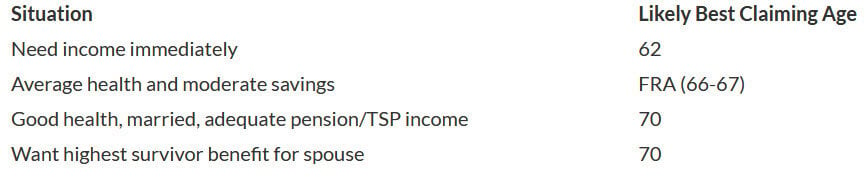
Age 62: Best If You Need the Income
The earliest age most workers can claim Social Security retirement benefits is 62. However, claiming before Full Retirement Age (FRA) permanently reduces your monthly benefit. Social Security retirement benefits are reduced for each month claimed before FRA.
Social Security Full Retirement Age
 Starting to take Social Security at age 62 may make sense if:
- You need income immediately after retirement
- You have health concerns that may shorten life expectancy
- You have limited retirement savings
For many FERS retirees who retire before age 62 and receive the FERS Special Retirement Supplement, claiming Social Security immediately at age 62 is often unnecessary because they already had a temporary Social Security-like benefit before age 62.

The purpose of the FERS supplement is to provide a portion of their retirement income to FERS employees who retire before age 62. The supplement is similar to what a retired FERS employee would have received in monthly Social Security retirement benefits had the employee retired at age 62 and elected to start receiving their Social Security retirement benefit.
SEE ALSO: Understanding the FERS Retirement Annuity Supplement
Full Retirement Age (66-67): The Middle Ground
As noted in the chart above, your Full Retirement Age depends on your birth year. For federal employees born in 1960 or later, FRA is age 67. At FRA, you receive 100% of your earned Social Security benefit.
Age 67 is often a reasonable claiming age if:
- You are retiring and need additional income
- You want to avoid the permanent reduction from claiming at 62
- You are uncertain about delaying to age 70
Age 70: Usually Best for Maximizing Monthly Income
Your Social Security retirement benefit increases for every month you delay claiming Social Security retirement benefits beyond FRA, up to age 70. For people born in 1943 or later, delayed retirement credits increase benefits by 8% per year. The increase stops at age 70.
Increase for Delayed Retirement
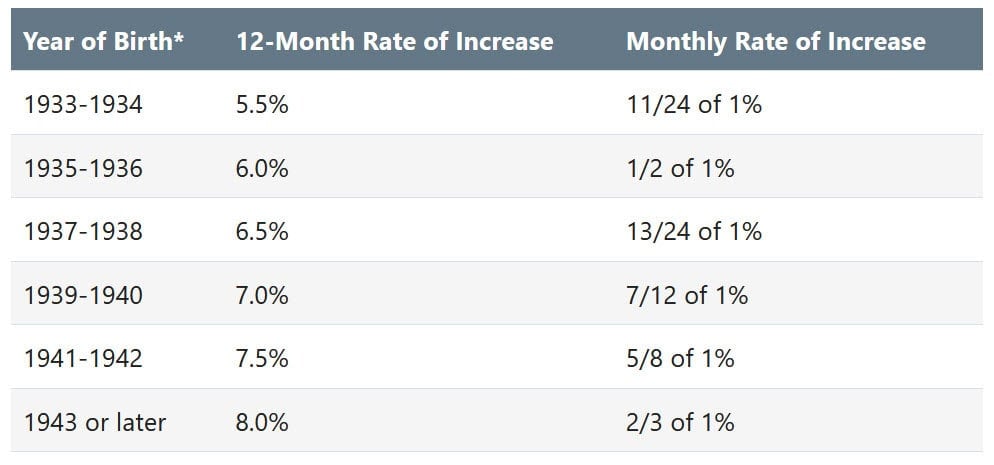
For many FERS retirees, age 70 produces the largest retirement income because:
- The monthly benefit can be about 24% higher than at age 67 (for those with FRA of 67)
- The higher benefit receives future cost-of-living-adjustments (COLAs)
- A surviving spouse may receive the higher benefit amount
If your health is good and you have sufficient income from your FERS annuity and TSP withdrawals, delaying to age 70 often produces the largest lifetime benefit.
Special Consideration for FERS Employees
FERS was designed as a three-part retirement system:
- FERS Basic Annuity
- Social Security
- Thrift Savings Plan (TSP)
Because FERS employees already pension, many have more flexibility to delay Social Security than private-sector workers who may rely heavily on Social Security income.
Considerations for When to Claim Social Security (FERS)
Use the Social Security Benefit Online Calculator
SSA provides a online retirement age tool to calculate your monthly Social Security payment based on your lifetime earnings. Just log in to your Social Security account to see if you’re eligible and how much you’ll get when you apply at different times between age 62 and 70. You can access the Social Security benefit calculator here.