
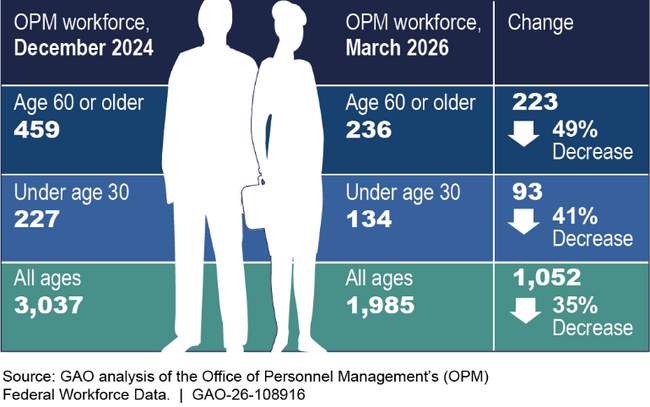
The Office of Personnel Management spent the past year and a half helping implement major changes across the federal workforce — deferred resignations, reductions in force and agency reorganizations. According to a new report from the Government Accountability Office, OPM wasn’t immune to those changes. The agency’s own headcount fell 35% between December 2024 and March 2026, a reduction of 1,052 employees — more than three times the more than 11% decline GAO found across 22 major federal agencies over a similar period.
One detail in that report should matter to anyone currently waiting on a retirement claim, or planning to retire soon: GAO found that OPM’s Retirement Services office — the unit that administers the federal civilian retirement systems — shrank by 16%, or 165 full-time-equivalent positions, from fiscal 2024 to fiscal 2026.
That raises an obvious question. OPM has spent 2026 racing to clear a record retirement backlog. How is it pulling that off with fewer people, and what does it mean for the wait times new retirees are actually experiencing?
The Backlog Is Falling
By the numbers, OPM’s progress on the backlog has been real. According to OPM’s Retirement Processing Status report, the pending inventory dropped to 24,784 claims at the end of July 2026 — the lowest level since the retirement surge began, and a decline of more than 62% from the February 2026 peak of 65,237.
| Month | Ending Inventory |
|---|---|
| February 2026 | 65,237 |
| March 2026 | 55,681 |
| April 2026 | 49,888 |
| May 2026 | 38,547 |
| June 2026 | 33,851 |
| July 2026 | 24,784 |
In July alone, OPM processed 17,841 claims while receiving 10,538 new applications. Its total pending inventory fell from 33,851 at the end of June to 24,784 at the end of July — a reduction of more than 9,000 cases in a single month.
That kind of throughput is the reason OPM has been able to point to the shrinking backlog as a success story, even as the agency operates with a substantially smaller workforce.

Processing Times Aren’t Improving
The backlog numbers don’t tell the whole story. Even as the number of pending claims has fallen sharply, the average time to process a retirement claim has held steady near its highest point of the year, rising from 60 days in March to 108 days in June and 109 days in July. There has also been a substantial and persistent gap between digital and paper claims. In July, claims processed digitally took 98 days on average, while paper claims took 156 days — nearly two extra months.
OPM says some retirement cases simply take longer to review, including those involving court orders, special benefit computations, workers’ compensation offsets, missing documentation, or applications that were deferred or postponed. Those cases can require additional review even as the overall inventory falls. That raises the possibility that some of the cases remaining in the pipeline will be among the more labor-intensive ones. But OPM’s published monthly statistics don’t show the complexity of the cases remaining in the backlog, so it’s not possible to say from the numbers alone how much that is contributing to current processing times. What the numbers do show is that a smaller backlog has not yet translated into substantially shorter average processing times.
Why GAO Is Worried About Who’s Left
The GAO report adds a piece of context the backlog numbers alone don’t capture: who actually left OPM. The number of OPM employees age 60 or older fell 49% between December 2024 and March 2026. At the other end of the workforce pipeline, 41% of OPM employees under age 30 separated during the same period.
But an even more significant number may be the experience level of the employees who left. GAO found that 57% of employees who separated from OPM had at least 11 years of federal service. Nearly one in five — 18% — had 31 years or more. That represents what GAO called a significant loss of institutional knowledge.
GAO has flagged skills gaps at OPM as a recurring, long-standing problem, and the agency’s own inspector general separately identified the workforce reduction as a top management challenge for 2026, citing immediate gaps in operational capacity. GAO’s broader concern isn’t simply the number of positions eliminated. It’s whether OPM can continue carrying out its mission with the staff and expertise that remain.
That question is particularly relevant to retirement processing. Some retirement claims involve unusual service histories, missing documentation, court orders, workers’ compensation or special computations that can require additional review and expertise. OPM has proposed using artificial intelligence and modernized IT systems in some offices operating with fewer employees. GAO noted those plans in its report, but it did not conclude that technology would offset the workforce reductions.
GAO also said its own review of OPM was limited by the agency’s response. It asked OPM for documentation on the changes it had made to its offices and programs since 2025, why it had made them, and how the agency plans its future workforce. Aside from weighing in on an early draft of the report, OPM never turned that material over, and it also declined GAO’s requests for a meeting or answers to written questions. Because of that gap in cooperation, GAO says it still can’t fully account for what OPM changed, the reasoning behind it, what it cost or saved, or how it will ultimately affect the agency’s ability to do its job.
What This Means If You’re Retiring Soon
The backlog is genuinely lower than it has been all year, and that’s good news for federal employees entering the retirement system. But the GAO report is a reminder that a smaller backlog and a faster personal retirement experience aren’t automatically the same thing.
OPM itself warns that cases requiring additional documentation, special calculations or other review can take longer. Examples can include:
- Service requiring a special computation
- Unresolved workers’ compensation issues
- Court orders affecting retirement benefits
- Missing or incomplete documentation
- Deferred or postponed retirement applications
- Other service or benefit issues requiring additional review
Filing method matters too. Paper claims have consistently taken close to two months longer than digital ones to process, and that gap has held steady even as OPM’s overall throughput has improved.
For most new retirees, that paper-versus-digital gap should become increasingly less relevant. OPM announced July 1 that it had ended paper processing for more than 95% of federal retirement applications, with nearly all new applications now being submitted and processed electronically through its Online Retirement Application system.
The practical advice remains much the same: use the digital retirement process available through your agency, make sure your retirement package and supporting records are complete, and work with your agency’s HR and payroll offices before retirement to resolve missing information that could hold up your claim.
It’s also important to plan financially for the period between retirement and final adjudication. OPM generally places eligible immediate retirees into interim pay while it finishes processing their claims, but the final annuity calculation can still take months.
The open question is: What happens next? OPM has reduced its retirement backlog dramatically while Retirement Services itself has undergone a 16% reduction in FTE staffing. At the same time, GAO says OPM as a whole has lost significant institutional knowledge, including hundreds of employees with more than a decade of federal experience. So far, Retirement Services has continued to push the backlog sharply lower despite those reductions. Whether it can turn that progress into meaningfully shorter processing times — particularly for cases requiring more complicated review — is worth watching in the months ahead.
Official OPM Resources on the Retirement Application Process
If you’re preparing to file, these are OPM’s own tools and guides for the application process:
- Retirement Quick Guide — OPM’s step-by-step reference covering the full timeline from submitting your package to receiving your first interim payment
- Retirement Processing Times — OPM’s monthly average processing times by claim type, plus factors that can extend your wait
- OPM Retirement Center — the main hub for retirement planning, applying, and managing your benefits
- Online Retirement Application (ORA) — overview of OPM’s digital filing system, including how pre-filled data and real-time annuity estimates work
- ORA Application Portal — where employees actually log in and submit an immediate retirement application
- OPM Retirement Support Center — FAQs and step-by-step guides for retirees, survivor annuitants, and their families
- Getting Started with Retirement Services Online — how to set up your post-retirement online account
- OPM’s YouTube Channel — official how-to videos on ORA, Services Online setup, and account management