

Your high-3 average salary is one of the most important numbers used to calculate your Federal Employees Retirement System (FERS) pension. Despite its name, it is not simply your highest-paid three calendar years. Instead, it is the highest average basic pay you earned during any consecutive 36-month period of federal service.
Understanding how the high-3 is calculated can help you estimate your future pension, evaluate retirement timing, and avoid common misconceptions.
Key Takeaways
- The high-3 is the highest average rate of basic pay over any consecutive 36 months.
- It is based on basic pay, not your total compensation.
- Overtime, bonuses, awards, travel reimbursements, and most allowances are not included.
- Annual pay raises that occur during the 36-month period are reflected in the calculation.
- For most employees, the high-3 occurs during the final three years of federal service—but not always.
When federal employees begin planning for retirement, one of the first questions they ask is: “What is my high-3 average salary?”
The answer is important because your high-3 is one of the three primary factors used to determine your FERS basic annuity:
- Your high-3 average salary
- Your years and months of creditable service
- The FERS pension multiplier
Even a modest increase in your high-3 can increase your lifetime retirement income.
Ad
Retire before 62, and there’s a benefit most feds forget to plan around
The FERS Special Retirement Supplement can bridge the gap until Social Security kicks in — if you know the eligibility rules and how it’s taxed. This workshop covers it, plus everything else on your path to retirement. Get the details at a free FedImpact Workshop near you.
What Is the FERS High-3 Average Salary?
The Office of Personnel Management (OPM) defines the high-3 average salary as the highest average basic pay you earned during any consecutive 36 months of federal service.
Many employees mistakenly believe the high-3 refers to their highest-paid three calendar years. In reality, OPM looks for the highest-paid 36 consecutive months, regardless of where they fall during your federal career.
For example, your high-3 period could be:
- July 15, 2024 through July 14, 2027
- October 1, 2023 through September 30, 2026
The dates do not have to align with the beginning or end of a calendar year.
What Counts as Basic Pay?
Only basic pay is included in your high-3 calculation. This is important because many forms of compensation that increase your paycheck are not considered retirement-covered pay.
Basic pay generally includes:
- Base General Schedule (GS) salary
- Locality pay
- Special salary rates
- Law Enforcement Availability Pay (LEAP), when retirement deductions are withheld
- Administratively Uncontrollable Overtime (AUO), when retirement deductions apply
- Other forms of premium pay specifically designated as basic pay for retirement purposes
Basic pay generally does not include:
- Overtime pay
- Cash awards
- Performance bonuses
- Recruitment or relocation incentives
- Travel reimbursements
- Per diem
- Uniform allowances
- Moving expenses
- Most premium pay that is not subject to retirement deductions
As a result, your W-2 wages may be significantly higher than your official high-3 average salary.

How the High-3 Average Salary Is Calculated
Please note: This article, the example below, and the worksheet provided are for educational purposes only to illustrate the importance of your high-3 average salary. Your official retirement calculation is performed by your employing agency and the Office of Personnel Management (OPM).
OPM does not simply average your last three annual salary figures. Instead, it identifies the consecutive 36-month period (equivalent to about 78 consecutive biweekly pay periods) with the highest average basic pay — and it weights each pay rate by exactly how long you held it during that window.*
This distinction matters most if you received a promotion, step increase, or locality change partway through your final three years. In that case, your 36-month window won’t be “three full years at three rates” — it will include a mix of your new (higher) rate and your prior rate, each counted only for the actual time you held it.
Example
Suppose an employee retires on June 30, 2027. Their consecutive 36-month high-3 window runs from July 1, 2024 through June 30, 2027, and includes three different basic pay rates:
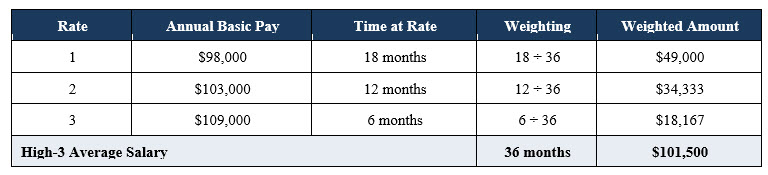
Note: this employee’s most recent, highest rate ($109,000) was in effect for only 6 of the 36 months. A simple average of the three annual figures ($98,000 + $103,000 + $109,000 ÷ 3 = $103,333) would overstate this employee’s true high-3 by about $1,800, because it assumes a full year at each rate.
Each rate is weighted by the fraction of the 36 months it covers:
$98,000 × (18 ÷ 36) = $49,000
$103,000 × (12 ÷ 36) = $34,333
$109,000 × (6 ÷ 36) = $18,167
High-3 average salary = $49,000 + $34,333 + $18,167 = $101,500
Why this matters: if you’ve had a recent promotion, step increase, or locality pay change, don’t estimate your high-3 by averaging your last three W-2 or annual salary figures. The actual calculation depends on exactly how long you held each rate within the 36-month window — which is why OPM (and any accurate high-3 estimate) works in pay periods, not calendar years.
*NOTE: OPM’s official calculation uses a 30-day-month/360-day-year convention rather than actual calendar days or pay periods; the pay-period framing above can be a close approximation useful for estimating purposes. You can review the full calculation using OPM’s handbook (173-page PDF).
Why Your High-3 Average Salary Matters
Your high-3 average salary is one of the three components used to calculate your FERS basic annuity.
For most employees, the formula is:
High-3 Average Salary × Years of Creditable Service × 1%
If you retire at age 62 or later with at least 20 years of creditable service, the multiplier generally increases to 1.1%, resulting in a larger pension.
Because the high-3 is multiplied by every year of service, even a relatively small increase can produce thousands of dollars in additional lifetime retirement income.
Example
Maria retires with:
- High-3 average salary: $120,000
- Creditable service: 30 years
- Standard FERS multiplier: 1%
Her annual FERS pension would be: $120,000 × 30 × 1% = $36,000 per year
If Maria qualified for the enhanced 1.1% multiplier by retiring at age 62 or older with at least 20 years of service, her annual pension would increase to:
$120,000 × 30 × 1.1% = $39,600 per year
That’s an increase of $3,600 annually before taxes.
Does Your High-3 Have to Be Your Last Three Years?
No. Although the final three years of federal employment are often the highest-paid because of annual pay raises and promotions, that is not always the case.
Your highest-paid consecutive 36 months could occur earlier if you:
- Accepted a lower-paying position before retirement
- Moved from a higher locality pay area to a lower one
- Left a position with a special salary rate
- Experienced a reduction in pay for another reason
OPM automatically identifies the consecutive 36-month period that produces the highest average basic pay.
Common Misconceptions
“It’s my highest three calendar years.”
No. The high-3 is based on 36 consecutive months, not calendar years.
“It includes overtime.”
Generally, no. Most overtime pay is excluded because it is not considered basic pay for retirement purposes.
“My W-2 salary is my high-3.”
Not necessarily. Your W-2 includes many forms of compensation that are excluded from the high-3 calculation.
“Working one more year always increases my high-3.”
Not always. If your earlier 36-month period already represents your highest average salary, working another year may not significantly change your high-3. However, another year of creditable service can still increase your pension.
Tips for Federal Employees
If you’re approaching retirement, consider these best practices:
- Review your SF-50s for accuracy.
- Verify that promotions and pay adjustments are correctly documented.
- Understand which types of pay count toward retirement.
- Estimate your FERS pension before selecting a retirement date.
- Remember that delaying retirement may increase both your years of service and your high-3 average salary.
Frequently Asked Questions
Does locality pay count toward my high-3?
Yes. Locality pay is generally considered part of your basic pay and is included in the calculation.
Do bonuses count toward my high-3?
No. Performance awards, cash awards, and bonuses are generally excluded.
Does overtime count toward my high-3?
Most overtime pay does not count because it is not considered basic pay for retirement purposes.
Can my high-3 come from the middle of my career?
Yes. OPM uses whichever consecutive 36-month period produces your highest average basic pay, regardless of when it occurred.
Who calculates my official high-3?
Your employing agency prepares your retirement records, and OPM makes the final determination when processing your retirement application.
Download the FERS High-3 Average Salary Estimator Worksheet
For educational purposes, you can download the free FERS High-3 Average Salary Estimator Worksheet (2-page PDF).