
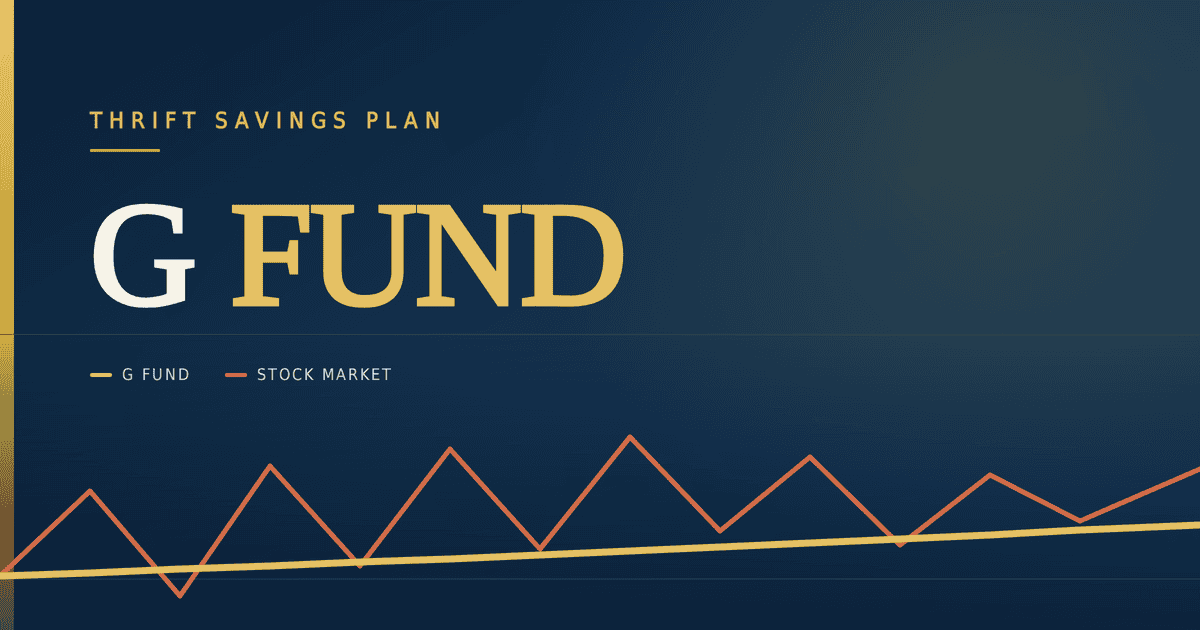
Thrift Savings Plan (TSP) participants transferred approximately $3.65 billion out of the G Fund in May, directing most of that money into the C and S Funds as stocks posted substantial gains. The C Fund received approximately $2.15 billion in net interfund transfers, while the S Fund received approximately $1.45 billion. The movement occurred during a month in which the C Fund gained 5.26% and the S Fund returned 4.49%.
Only about 2% of TSP participants moved money between funds, according to materials prepared for the Federal Retirement Thrift Investment Board’s June meeting. Approximately 98% stayed with their existing allocations.
The transfers nevertheless raise a question that extends beyond one month’s market results: Should TSP investors remain in the G Fund when stocks are rising, or does doing so sacrifice too much long-term growth?
There is no single answer for every participant. The G Fund protects against market losses in a way that the other TSP funds cannot. But its returns have not always kept up with inflation, particularly during the inflation surge earlier this decade. The decision involves two different risks: the risk of losing money in the market and the risk that savings will not grow fast enough to maintain their purchasing power.
Participants shifted billions toward stocks
The May interfund-transfer activity showed a clear movement from safety toward stock-market exposure.
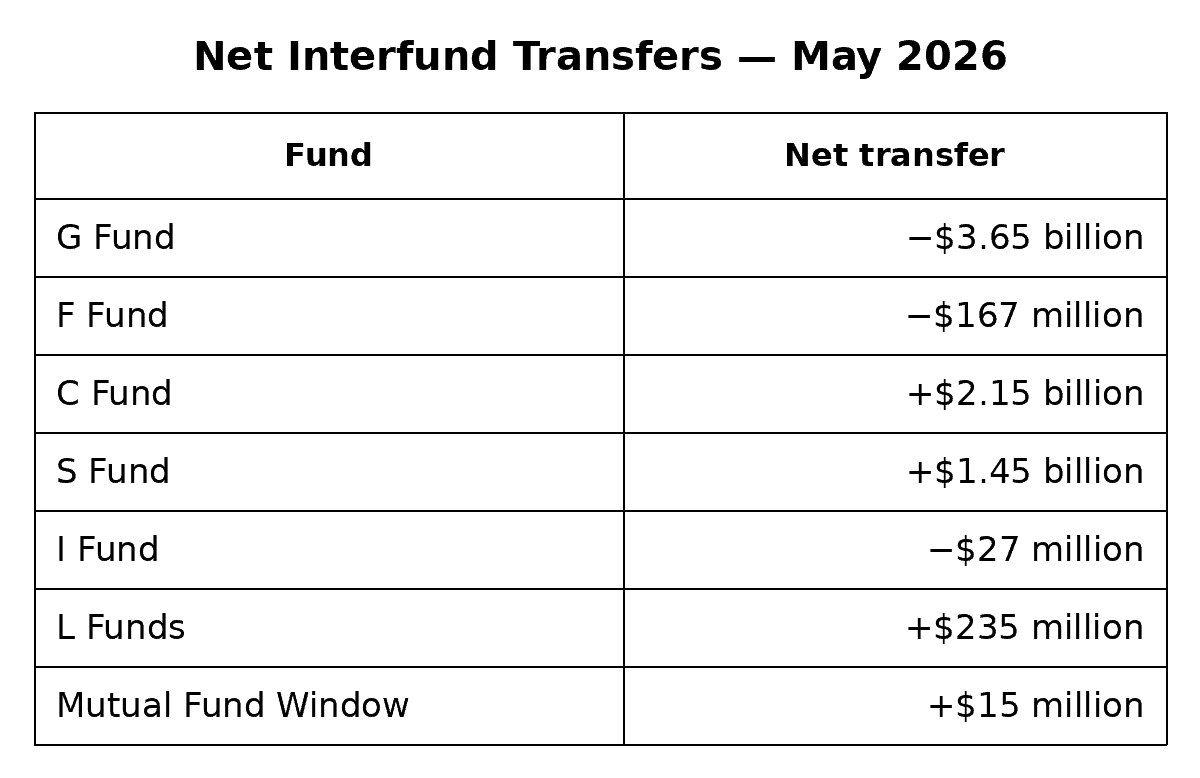
These figures represent net transfers of existing account balances. They do not include payroll contributions, agency contributions, loan repayments or investment gains. The timing matters. Through the end of May, the C Fund had gained 11.26% for 2026, while the S Fund had returned 13.48%. The I Fund led the core funds with a return of 16.56%.

Participants who moved from the G Fund into the C or S Fund increased their opportunity to benefit from additional stock-market gains. They also accepted the possibility that stocks could reverse direction after the transfer. The data do not reveal why individual participants moved their money. Some may have been restoring a planned allocation or correcting an account that had become too conservative. Others may have been reacting to recent stock returns. That distinction is more important than the transfer itself.
What makes the TSP G Fund different?
The G Fund invests in short-term U.S. Treasury securities specially issued to the TSP. Payment of principal and interest is guaranteed by the federal government. The fund does not experience negative returns caused by changes in market prices.
FRTIB has described the G Fund as producing longer-term Treasury yields without market risk. Its interest rate is based on the weighted average yield of outstanding Treasury securities with four or more years to maturity, even though the special securities held by the fund are issued daily. Because long-term rates typically run higher than short-term rates, this arrangement usually lets G Fund investors earn more than they would from a short-term Treasury bill of similar safety. This arrangement gives TSP participants access to a combination that is generally unavailable in ordinary investments: returns based on longer-term government securities without the risk that rising interest rates will reduce the market value of those securities.
The F Fund, by comparison, invests in a bond index and can lose value when interest rates and bond prices move against it. The C, S and I Funds are exposed to stock-market declines.
The G Fund’s protection is therefore real and valuable. But “no market risk” does not mean “no risk of any kind.” TSP’s own fund page for the G Fund is direct about this trade-off, cautioning investors that the fund “will not grow enough to offset the reduction in purchasing power” when inflation runs high enough.
The case for keeping money in the G Fund
The strongest argument for the G Fund is certainty.
A participant knows that money in the fund will not be reduced by a stock- or bond-market decline. That can be particularly important when the money may be needed soon. A federal employee approaching retirement may not have enough time to recover from a major stock decline before withdrawals begin. A retiree already taking TSP distributions may also want part of the account protected from short-term market losses. Holding stable assets can reduce the need to sell stock investments during a downturn. If stocks fall just as withdrawals begin, selling shares to cover current expenses can leave fewer shares available to participate in a later recovery. The G Fund can also help participants tolerate the market volatility in the rest of their accounts. An allocation does not have to be entirely in the G Fund or entirely in stocks. The G Fund can serve as the stable portion of a diversified portfolio.
The TSP’s Lifecycle Funds illustrate this approach. Each L Fund combines the G, F, C, S and I Funds in proportions based on an expected withdrawal period. As a target date approaches, the allocation gradually becomes more conservative. FRTIB has revised the L Funds’ glide path in recent years, moving to quarterly allocation adjustments and raising the L Income Fund’s target stock allocation to 30%, while still keeping the G and F Funds as the fixed-income anchor of every L Fund.
Remaining in the G Fund during a stock surge can therefore be reasonable when the allocation reflects the participant’s withdrawal needs, time horizon and ability to withstand losses.
The case against holding too much in the G Fund
The argument against a large G Fund allocation is primarily about long-term purchasing power.
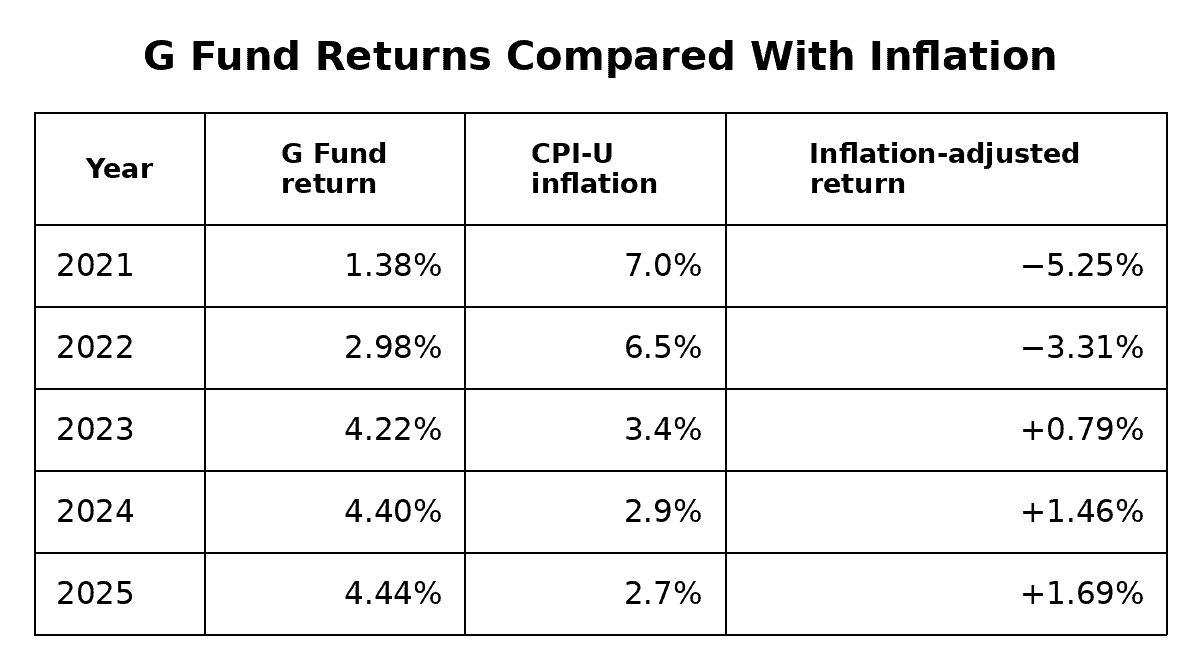
Although the G Fund cannot lose money through a market decline, the prices of goods and services can rise faster than the account’s value. When that happens, the participant has more dollars but less purchasing power. This was particularly evident in 2021 and 2022. The following comparison uses annual G Fund returns reported by FRTIB and the December-to-December change in the Consumer Price Index for All Urban Consumers reported by the Bureau of Labor Statistics.
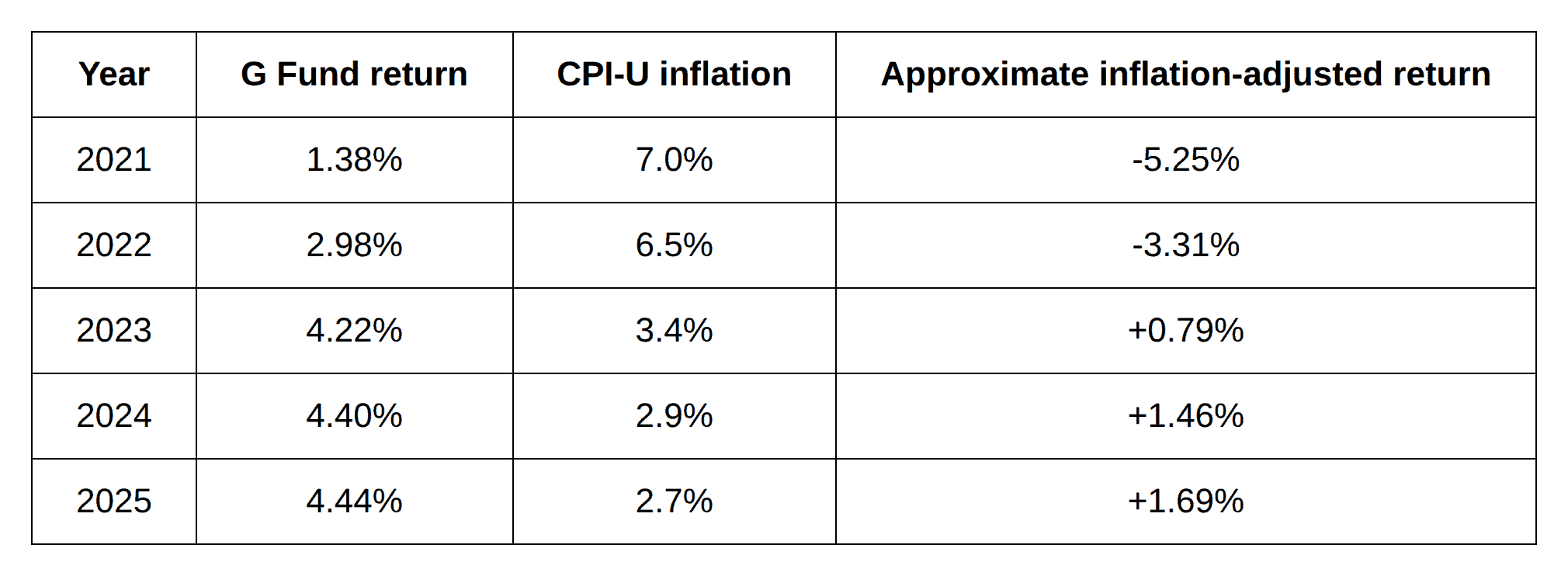
The inflation-adjusted return is calculated as:
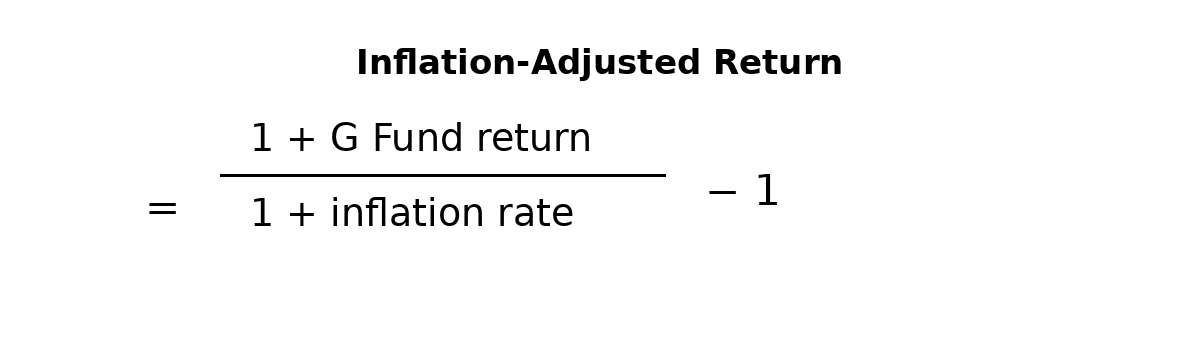
This is more precise than simply subtracting inflation from the fund return. The figures show that the G Fund lost purchasing power in 2021 and 2022, when inflation was unusually high. It produced positive inflation-adjusted returns in 2023, 2024 and 2025 as its return increased and inflation moderated.
Over the full five-year period, the G Fund gained approximately 18.6%. Consumer prices increased approximately 24.5%, based on the annual BLS inflation figures compounded over the same period. That translates into an estimated cumulative inflation-adjusted G Fund return of approximately -4.7%. In other words, an account invested in the G Fund grew in dollar terms over those five years, but the cumulative increase did not fully match the rise in consumer prices.
What the inflation comparison does—and does not—show
The five-year comparison demonstrates a genuine limitation of the G Fund, but it should not be interpreted as proof that the fund failed. The period began with the highest inflation in decades. Interest rates subsequently rose, and the G Fund’s return adjusted upward. By 2023, its annual return was again exceeding the December-to-December CPI increase. Inflation also affects households differently. The CPI-U is a broad national measure covering the spending patterns of urban consumers. An individual retiree’s expenses may rise faster or slower depending on housing, health care, travel, food, insurance and other costs.
The comparison also does not account for taxes. Traditional TSP withdrawals generally produce taxable income, while qualified Roth withdrawals are tax-free. Taxes can reduce the amount available for spending from a traditional balance. Most importantly, inflation protection is not the G Fund’s only purpose. Its principal function is to provide stable returns without market losses. A participant accepting a lower expected return in exchange for certainty may be making an intentional trade-off rather than an investment mistake.
Stocks offer more growth — and more risk
The C, S and I Funds have historically offered greater growth potential than the G Fund, but their returns can vary sharply from year to year. The C Fund tracks large U.S. companies. The S Fund covers small and midsize U.S. companies not included in the C Fund’s index. The I Fund invests in international stocks outside the United States, excluding China and Hong Kong under its current benchmark.
None of these funds guarantees principal. A participant moving from the G Fund into stocks after a rally is not receiving the returns that occurred before the transfer. The participant will receive only the gains or losses that occur afterward. That creates one of the central risks of performance chasing. A participant may wait in the G Fund while stocks rise, move into stocks after seeing strong returns, and then move back to the G Fund after a decline. The result can be buying at higher prices and selling after losses.
This does not mean participants should never change their allocations. It means the reason for a change matters. A transfer intended to maintain a predetermined allocation is fundamentally different from a transfer based on a prediction about what markets will do next.
Market safety and retirement safety are not identical
The G Fund protects account balances from market losses. But retirement security involves more than avoiding a decline in the account statement.
A participant may face several competing risks:
- Market risk: Stocks and bonds may decline.
- Inflation risk: Prices may rise faster than savings.
- Longevity risk: Retirement savings may need to last longer than expected.
- Withdrawal risk: A downturn may occur as withdrawals begin.
- Behavioral risk: A participant may buy or sell in reaction to market movements.
The G Fund directly addresses market risk. Stocks may provide more protection against long-term inflation and longevity risk through higher growth, but they introduce volatility and the possibility of substantial losses.
A diversified allocation attempts to balance these risks rather than eliminate one while ignoring the others.
Time horizon changes the question
Whether the G Fund is serving a useful purpose depends partly on when the money will be needed. An employee many years from retirement has more time to recover from market declines. For that participant, holding a very large G Fund allocation may create a greater risk of insufficient long-term growth.
An employee approaching retirement has less time to recover from a severe downturn. Protecting part of the account may become more important, particularly if withdrawals will begin soon. A retiree taking regular distributions may value having stable money available during stock-market declines. But a retirement lasting 20 or 30 years may still require growth to help offset inflation.
Other retirement income also matters. FERS or CSRS annuity payments, Social Security, outside savings and household expenses can affect how much risk a participant needs—or can afford—to take in the TSP. These considerations explain why the same allocation may be appropriate for one participant and unsuitable for another.
Staying in the G Fund is also a decision
Participants sometimes view leaving money in the G Fund as avoiding an investment decision. In reality, remaining in the fund is itself an allocation decision. It provides protection against a market loss but limits participation in stock-market gains. It may preserve principal over short periods while losing purchasing power during periods when inflation exceeds its return. Moving out of the fund carries its own consequences. A participant receives more growth potential but gives up the G Fund’s guarantee against market losses.
The May transfer figures show that some participants were willing to make that exchange after stocks had already produced substantial gains. Whether those moves ultimately help or hurt will depend on future market performance, which cannot be known in advance.
The more durable question is whether each participant’s allocation is designed for that participant’s retirement timeline—or whether it changes in response to the market’s latest direction.
Helpful Resources:
- TSP.gov: G Fund fact sheet — full breakdown of the fund’s objective, holdings and risk disclosures, straight from TSP.
- TSP.gov: Rates of return — monthly and annual return history for every TSP fund.
- TSP.gov: Investing strategies — TSP’s own guidance on building an allocation around your timeline and risk tolerance.
- TSP.gov: Lifecycle Funds — how the L Funds automatically blend the G, F, C, S and I Funds based on your target retirement date.